
Champagne de Castellane Tower & Heritage Visit in Épernay
Champagne de Castellane is one of Épernay's most visually distinctive Champagne houses. Its identity is built as much around architecture and heritage as around the wines themselves: the 66-metre tower rises above the town, while the house preserves a substantial collection of Champagne history, poster art, labels and regional material.
The current visitor appeal is tower- and heritage-led rather than cellar-led. de Castellane states that its cellars are temporarily closed to the public, so a realistic Champagne itinerary should treat the house as a place for panoramic views, museum collections, Belle Époque identity and tasting, not as a guaranteed underground-cellar visit.
What makes de Castellane distinctive?
- Historic Épernay identity: founded in 1895, the house is closely associated with Belle Époque visual culture, the red Saint Andrew's Cross and an early tradition of poster art.
- Listed tower: the 66-metre tower has 237 steps and offers a 360-degree view across Épernay and the surrounding vineyards.
- Champagne heritage collections: the visit can include museum and permanent-exhibition access, with the Heritage Tour adding the Salle des Étiquettes and its large collection of historic labels and collars.
- Different from a standard cellar tour: de Castellane works best when the route needs architecture, history and views as a contrast to a more wine-led or cellar-led house.
Signature style
The wines are built around Chardonnay, Pinot Noir and Pinot Meunier, vinified separately by cru and grape before blending. For visitors, however, the strongest public distinction is not a narrow terroir claim or prestige-cuvée story; it is the combination of heritage setting, tower, collections and accessible tasting.
Use the current tasting programme as context rather than treating the page as a bottle catalogue. Depending on the visit format, tastings may include Brut Croix Rouge and another house cuvée, but exact pours and availability should be confirmed for the date of travel.
Visitor experience
The guided Tower visit includes access to the museum, the listed tower, the permanent exhibition, panoramic views and a tasting. Current public formats include a 60-minute Tower Visit with one tasting and a 75-minute Tower Visit with two tastings, each limited to small groups.
The Heritage Tour is longer and more collection-focused, adding access to the Salle des Étiquettes, where thousands of historic Champagne labels and collars are preserved. It is reservation-only, limited to a smaller group, and useful when the guest is genuinely interested in Champagne history rather than only a quick tasting stop.
Because operational details are time-sensitive, we recheck opening, language, group size and the cellar-closure status before building de Castellane into a private Champagne day.
Who is de Castellane best for?
de Castellane is best for visitors who want a visually memorable Épernay stop where architecture, panoramic views, Belle Époque history and regional heritage are central to the experience. It suits travellers who like context and place identity as much as the tasting itself.
It is less ideal for guests whose priority is currently a full working-cellar visit, or for travellers seeking the most technical, terroir-led tasting in the Épernay benchmark-house group.
Nearby lunch, stay and dinner context
For lunch, de Castellane can fit with Épernay options such as Why Not or Au Petit Fourneau, while Chez Max in Magenta may be relevant when the wider route makes sense. For overnight planning, Épernay bases such as L'Interface Chambres d'Hôtes, Hôtel Jean Moët or Suites A.B. keep the day compact.
Dinner should be treated as part of the Épernay evening base rather than ranked only by distance from the house. La Cave à Champagne, Le Théâtre and La Grillade Gourmande are examples of the kind of local evening options to consider around the stay plan.
How it fits into a Champagne route
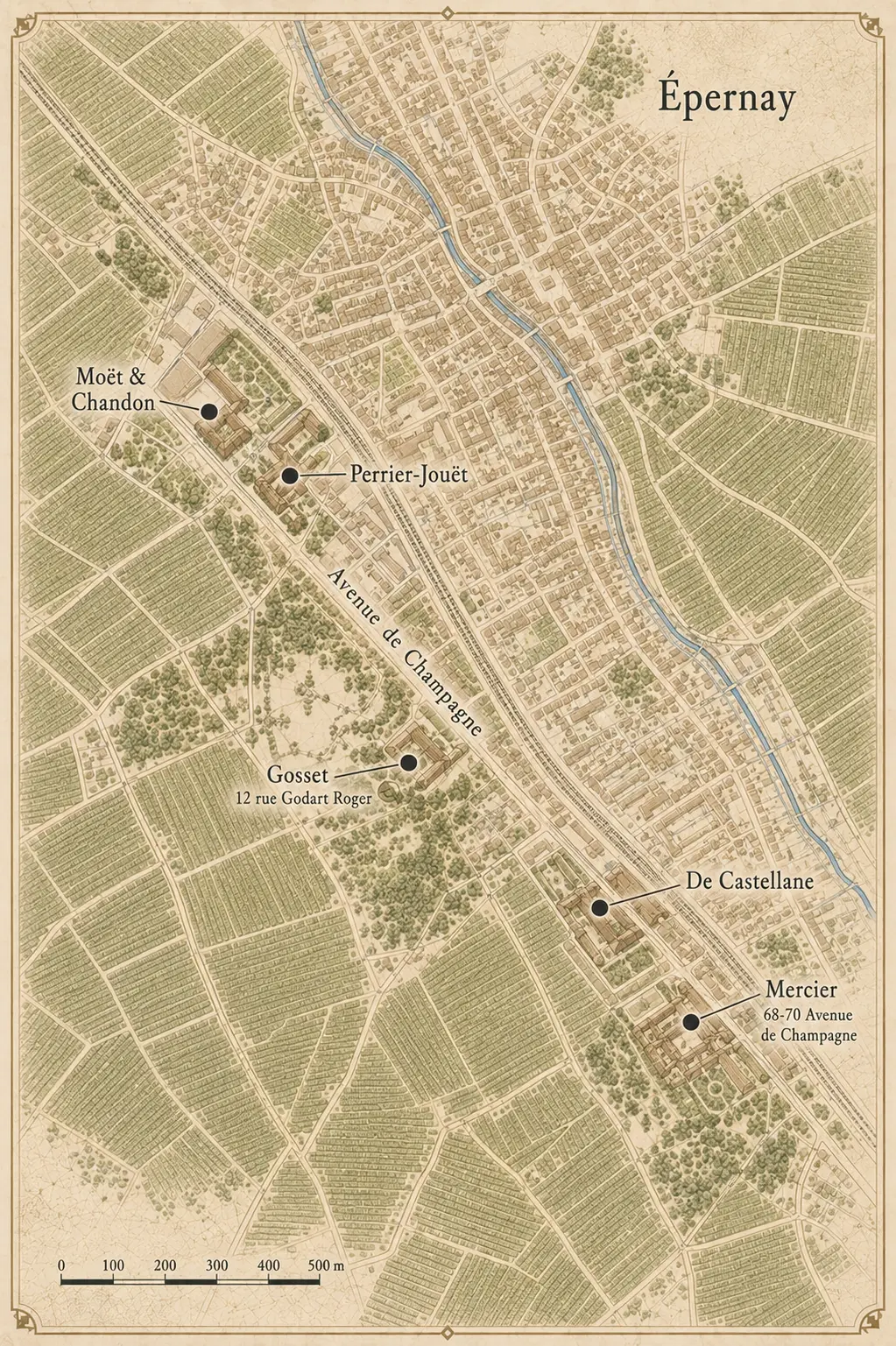
de Castellane fits naturally into a central Épernay day, especially where the route already includes a more wine-led or cellar-led house. In the same Épernay benchmark set, it can be compared with Mercier for accessible visitor storytelling, Perrier-Jouët for visual and aesthetic identity, or Moët & Chandon for major-house scale.
For contrast, Gosset gives a quieter and more wine- or gastronomy-led counterpoint. Choose de Castellane when the tower, panoramic view, poster-art legacy and museum collections are part of the reason for visiting, not when the itinerary needs another conventional cellar tour.